
When I first heard about us ai olympiad, I was struck by how it offers a real chance for young students to dive into the world of artificial intelligence — long before college or corporate jobs. For many high‑schoolers with curiosity and coding skills, this can be their launch pad into the future of AI. The concept of US AI Olympiad brings together learning, challenge, and competition under one roof. Companies like Aim IT Solution follow such AI initiatives closely to stay informed about emerging technologies and the next generation of tech talent.
What exactly is this Olympiad?
The competition is organized by USAAIO, which runs the national‑level contest USA‑North America AI Olympiad (USA‑NA‑AIO).
The goal: to identify and nurture talented K‑12 students (mostly high school) who show promise in artificial intelligence.
Who can participate
The USA‑NA‑AIO is open to middle school and high school students in the U.S. and Canada (or permanent residents), as long as they are under 20 years old at the time of international competition and are not full‑time university students.
How the competition works
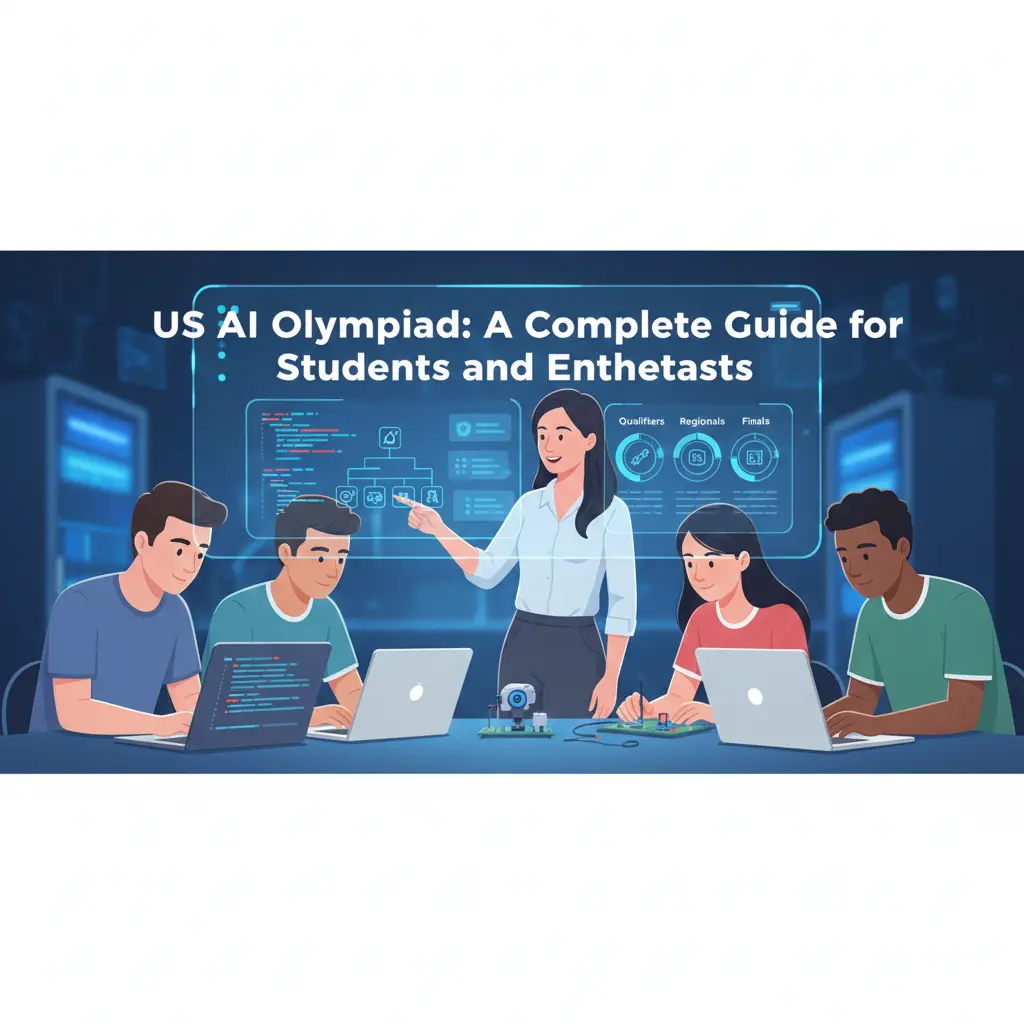
The Olympiad consists of three main phases: Round 1, Round 2, and then a final “camp” for top performers. Round 1 is open to all eligible students and involves tasks like basic coding, foundations of machine learning or AI, and some mathematics related to AI.
If a student performs well in Round 1, they get an invite to Round 2 — which is more advanced and may involve GPU‑based tasks such as deep learning or convolutional neural networks.
Those who clear Round 2 qualify for the USAAIO camp, where teams are formed and the final selection for international representation happens.
Why it matters
The US AI Olympiad isn’t just another coding contest. It aims to inspire young minds to solve real‑world problems using AI. As per the organizers, one big objective is “real‑world problem solving,” where students apply AI to tackle issues ranging from sustainability to business analytics.
Additionally, the USA‑NA‑AIO serves as the gateway for select students to represent the U.S. in global competitions: the International Olympiad in Artificial Intelligence (IOAI) or the International Applied AI Olympiad (IAIO).
For instance, in 2025, students selected via USAAIO represented the U.S. in IOAI.
Recent Results & Impact
At the 2025 IOAI, the U.S. team secured three Silver medals, three Bronze medals, and one Honorable Mention.
This demonstrates that the US AI Olympiad pipeline can produce competitive, high‑performing participants on the global stage.
Such achievements matter because they show that machine learning and AI skills are being fostered at the high school level. For students, this is not just a competition — it’s a head start in a field that’s going to shape our future. Competitions like US AI Olympiad help build foundations: coding, problem‑solving mindset, collaboration, and exposure to international standards.
How this can inspire you (or others)
If I were a high‑school student passionate about AI, I’d see US AI Olympiad as a golden opportunity. It gives you structure — a progression from basics to advanced AI coding, a realistic taste of what global-level AI problems might require, and a chance to network with peers who are equally interested.
Even if you don’t make it to the international team, participating itself can be a massive learning experience. You get to code in environments like Google Colab, tackle math and AI tasks, and improve your understanding of machine learning, deep learning, and AI fundamentals.
A note for non‑US students / global learners
Because US AI Olympiad (USA‑NA‑AIO) is limited to students from U.S. and Canada (or permanent residents) — eligibility depends on residency or citizenship or studying full‑time in U.S./Canada.
That means if you are from India (like me or you), this exact competition may not be accessible directly. But — and this is important — the model of “AI Olympiad for high schoolers” itself is powerful. One can look for similar national or international AI contests open worldwide, or even start building projects on open‑source platforms, treat them as self‑made “AI Olympiad,” and build a strong portfolio.
Given your background (web dev, digital marketing, interest in AI/SEO), you could start experimenting with small AI or ML projects now — build something, document it, maybe open‑source it. That kind of self-driven build may appeal as much (or more) to clients, recruiters or collaborators, as formal certifications.